
For 16 years, we’ve been dedicated to creating trusted, easy-to-follow recipes to help home cooks feel confident and excited in the kitchen. The recipes you’ll find on Inspired Taste reflect how we truly cook at home: simple, fresh, and so flavorful, you might just want to do a little happy dance after taking a bite.
Since the introduction of AI (Artificial Intelligence), AI generated recipes are finding their way into almost every corner of the internet, and since we care deeply about our readers’ success in the kitchen, we’ve been speaking out about it.
⭐️ If we have one tip for home cooks, it’s this: Don’t use AI recipes.
What You Should Know
- AI gets things wrong all the time.
- Adam calls these AI-generated recipes “Frankenstein recipes,” which paints a good picture of what they actually are. They are derived from any number of recipes, taking a bit from one and a bit from another, and then smooshing them together to make it look like an authentic, trustworthy recipe. It looks real, but it isn’t.
- These recipes have NEVER been proofread or checked by a human, made in an actual kitchen, or ever been tasted. That’s why they are riddled with mistakes, are misleading, and why we think you should skip them altogether.
What You Can Do
- Tell your friends and family. In talking with our peers, journalists, and loved ones, we’ve realized that many people don’t know how these recipes are constructed or why they should be wary of them.
- Save your money and ingredients, skip the AI, and go directly to food creators and recipe sources you trust.
We’re obviously passionate about all of this, having been quoted in articles about AI. Adam has been very vocal on X and on his Linkedin page (where much of the online chatter about this happens), and we’ve even been quoted in the legal arguments of a key AI court case (paragraph 123) after our interview with Gregg Finn on Marketing O’Clock.
This all extends far beyond just food, and while we could elaborate further, you follow us for cooking inspiration, so we’ll keep it about recipes for now.
As always, we appreciate YOU, because without you, we would not be able to do what we love.
Read on to learn about what we’ve been doing about all of this, what some of our readers have had to say, and ways we think the internet can be better:
Warning Our Readers
We’ve been discussing this issue for a while. In December 2025, we posted a video on Instagram explaining why we believe AI recipes can be harmful.
Over the years, we’ve noticed that many of our readers feel overwhelmed in the kitchen—just like we do sometimes. We get why quick answers are appealing. But using AI for recipes is risky. None of the recipes you find through Chatbots or in AI Overviews at the top of search engines like Google have actually been made by a person. AI can’t taste or test recipes.
Despite this, AI recipes are continuously flooding all the places we tend to look for recipe inspiration. We see them forced into prominent placements on search engines and across social networks. And this happens even when you are searching for our recipes by name.

One example we show in our video is a user searching for “Inspired Taste banana bread recipe.” Historically, if you were to type that into Google’s search bar, the search results would provide a direct link to our banana bread recipe at the top.
In the example in our video, the search result shows an AI result with a Frankenstein or AI-generated recipe for our banana bread. The recipe claims to be an Inspired Taste recipe, but in reality it is not and, in fact, differs from the real recipe on our website. This is just one of many examples we have that shows an AI-generated output misrepresenting our recipes and name.
What Our Readers Had to Say
After sharing this with our readers, many thanked us because they didn’t realize that the recipes displayed in search were AI-generated or that we weren’t giving Google and other AI companies permission to misuse our content like this. Here’s what some of them had to say:
- “I had no idea about this! I have seen some of these and even saved some. I will go through and delete them and only follow those I know are real people. Thank you so much for sharing this video! I will also share this!”
- “I had no idea this was a thing but no it all makes sense. I tried to follow recipe but was missing instructions on ingredients listed. I thought it was a typo it didn’t come out right and I consider myself a decent cook. I was left discouraged and puzzled. Thank you for sharing this!”
- “I didn’t know this was going on and I don’t like it at all. When I search for something want to know I can trust it. Thank you for the tips on how to spot the fake.”
- “Had no idea this was happening! I’m not an intentional Al user, but I’m glad to know Google searches give Al results the prime spot and to be careful. Thank you for letting people know this is a problem!”
- “I agree! Within the last few days I did a search for a recipe l’ve made countless times and I got a Frankenstein recipe. I had made the recipe enough times that I knew it was wrong. What bothered me the most was I entered the blog name and the recipe name, but the Frankenstein recipe came up instead of the blog I searched for! I was extremely frustrated! I’m used to being able to being able to do a verbal search and that just doesn’t seem to consistently work anymore.”
More Examples of AI Responses Misleading Users
Here’s another video we posted not long after. In it, we make our key lime pie recipe and also try the version suggested by an AI Mode response, which it called “Inspired Taste’s key lime pie.” Like with the banana bread example above, AI confidently claims the recipe is from Inspired Taste.
Like most AI responses we’ve seen, the AI chat is very confident and presents its answers as if they are completely accurate. It is hard to imagine anyone, upon being presented with this AI recipe, questioning it as incorrect, even though it is, in fact, completely different from our original recipe (the one it claims to be).

After sharing that video, Joanne was interviewed by Kelly Evans and Brian Sullivan on CNBC Power Lunch. You can see the comparison between our real recipe and the AI-generated one in the screenshot below. The one on the left is the Google branded “Inspired Taste” Key Lime Pie and on the right is our actual Key Lime Pie Recipe.

You can see they are quite different. This is why we have been so vocal in telling our own readers to be careful with AI outputs. If they are looking for one of our recipes, the safest option would be to come directly to us. If they see a recipe outside our website claiming to be ours (especially if it is in a chatbot or AI Overview), it will very likely not be accurate.
Even More Examples!
Here are a few more examples, since we have plenty to share. The thing with AI answers is that they keep changing. We’ve asked a chatbot for one of our recipes several times, and each time, the answer is different. Sometimes the ingredient list changes or the amounts differ. It ranges from verbatim plagiarism to wildly inaccurate. Still, every response claims to be correct.
This example concerns our mayonnaise recipe. If you look at the screenshot below, you’ll notice the ingredient list is different. Our actual recipe uses more mustard and less lemon juice than the version in the AI output.
Even with this, notice the statement: “The highly popular Inspired Taste Homemade Mayonnaise is a fail-proof two-minute recipe…” This sounds convincing, but it’s not actually our recipe. Worse still, this output is shown above traditional search results, which pushes us down on the page. (Note that the blue text in the output linked to a social media account, not our recipe page.)
You can also see that our YouTube video is used in this output, which compounds the misrepresentation. When looking at this output, why would a user ever consider that it might be incorrect?

Here’s another example. This time of a response we got after asking Google’s AI Mode about our Inspired Taste Pho Recipe. Since we know our own recipe, we can say for sure that it starts with making broth from scratch. But the AI response says, “Inspired Taste Homemade Pho is designed to be an accessible, ‘shortcut’ version that infuses store-bought beef broth…” That’s not true. Our real homemade pho recipe never suggests using store-bought beef broth. In fact, we actually advise against it (see the tips section below our recipe).

You Might Wonder, What’s the Harm?
Let’s use the Pho recipe example we just shared above.
- First, the person who asked for our recipe didn’t actually get it, which is disappointing.
- Second, because the AI answer sounds so confident, the user might never realize that we advise against using store-bought broth. They could make the recipe, not like it, and then blame Inspired Taste for the results. This hurts our brand trust and the possibility that this user will seek our recipes out in the future.
- Finally, because this output competes with us in traditional search, it significantly hurts our traffic and the ability for people to find us, which directly hurts our business.
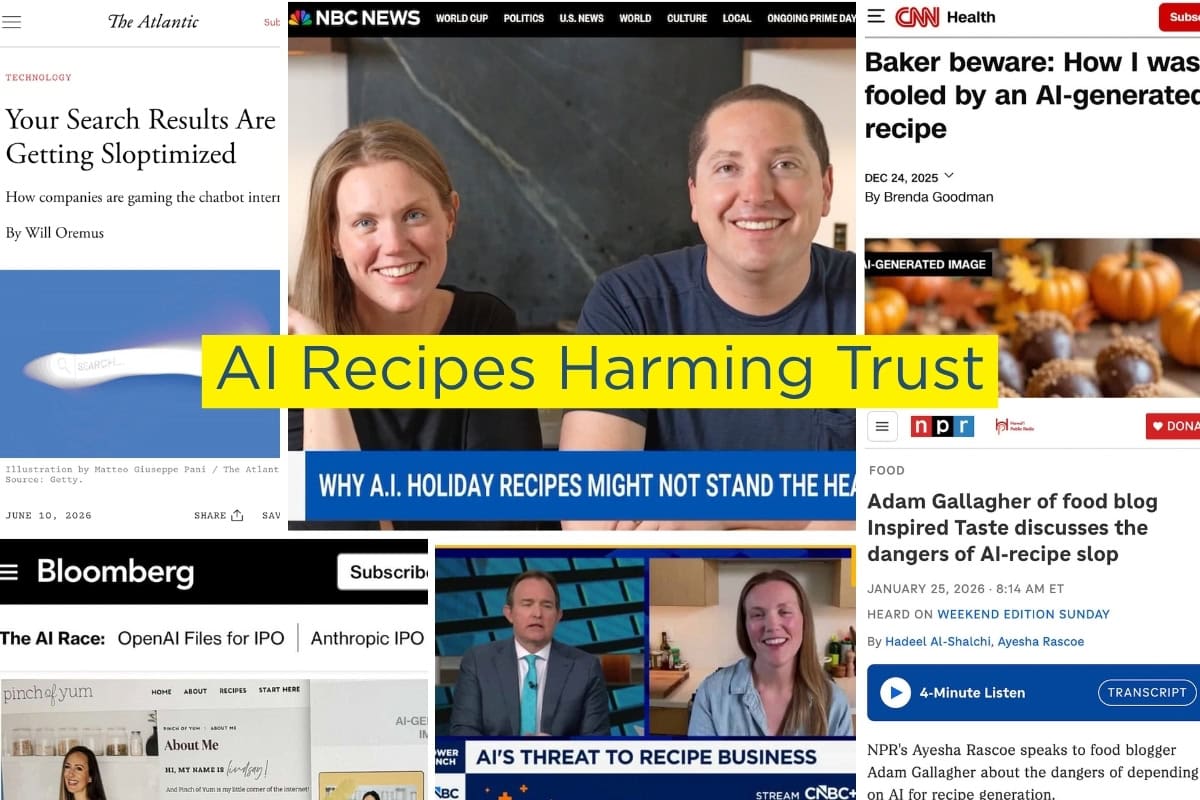
We’re not the only ones warning people about trusting AI recipe results. You can find a list of articles below where we and others in our industry have spoken out.
From talking with our readers, it also seems many are catching on. We recently surveyed over 2,000 people about how they search for recipe inspiration. We found that “home cooks are 300% more likely to turn to food blogs than AI for recipe inspiration, and 125% more likely to use physical cookbooks than AI.”
Hearing this is a bit of a relief, but we’re still concerned. If people lose trust in online recipes because of AI, it could hurt both our readers and our business. And if AI outputs replace us or push us down in the search for recipes, real, human-tested recipes are in trouble. And, for branded searches, such as the Inspired Taste Pho example we mentioned above, the AI response appears above our original recipe link, which puts us at a disadvantage. Worse, the AI output is incorrect, which damages our brand trust.
If all that wasn’t enough, AI can’t taste or taste, so in order to even generate these Frankenstein recipes, their models train on websites like Inspired Taste and others by scraping. In other words, our content has been stolen and used to compete against us. This is not sustainable.
For even more examples, including videos, see Adam’s X thread below, as well as this article Google’s AI Frankenstein Recipes Are A Horror, written by Barry Schwartz, founder and editor of Search Engine Roundtable. This article The Power of Personalized Intelligence, from Glenn Gabe, founder of G-Squared Interactive is also helpful in understanding how personalized intelligence can compound this issue even more. In this article, he shared an AI Mode output with a branded Frankenstein recipe for our Key Lime Pie because he had frequented our website. The recipe was riddled with errors as covered in this Search Engine Roundtable article.
By far, the highest priority needs to be removing full Frankenstein recipes as default on AI Mode and AI Overviews for recipe intent queries, especially branded, like this example recorded minutes ago. 🧵(2/4) pic.twitter.com/RQH7hNhaZg
— Inspired Taste (@inspiredtaste) March 4, 2026
What Can You Do
If you’re a home cook who enjoys finding recipes online, we’re so glad you’re here. Here are some tips for you:
- If you get a full recipe from a chatbot like ChatGPT, Gemini, or Google’s AI Mode, it is AI-generated. This is also true if you see a full recipe in an AI Overview when doing a Google search. If you want the real thing, seek out real creators like us (we and those like us will always be there for you!). Join our newsletters, follow us on social media, buy our cookbooks (we don’t have one yet, but that’s changing!), and bookmark our websites.
- Don’t immediately turn your back on search engines, Pinterest, and social media. Real human creators are still there! Look for us. If it’s getting harder to find us, leave feedback with the platform asking why AI-generated content is surfaced over trusted sources.
- When reading recipes, if something seems off or the ingredients don’t match the directions, give it a pass. Look for who shared the recipe, whether there’s an about page, and whether there are comments on the website written by real people. Does anything about where you found the recipe seem fake? If so, move on.
- If all else fails, leave a comment below or email us (contact @ inspiredtaste.net), and we can help. If we don’t have the recipe you want, I bet one of our favorite recipe sites does, so we will send you there.
If you’re a creator who shares our concerns, speak up. Take screenshots and videos that show how AI can distort the truth or mislead people about you, your work, or your brand. Real examples make it easier to explain the problem and show engineers how their products affect people online.
Change is Possible
If you want things to change, know it’s possible and in some cases already happening. For example, several key court cases are looking at whether AI companies can use creators’ work without paying them by claiming fair use. States, like New York, and other countries are considering new rules to ensure AI is used more responsibly. And some AI companies are starting to listen to our feedback that their AI tools are eroding trust in the online ecosystem while also hurting creators.
For example, after years of sharing some pretty shameful examples online showing how Google’s AI products were hurting our brand and pleading for change, we’re seeing some change in direction.
Here’s a better example @rmstein & @rajanpatel. The AI recipe is an overview. We still have major accuracy concerns but the full AI recipe is no where in sight. This is useful to searchers and will be much better for the ecosystem. (2/2) 🧵 cc @lilyraynyc @glenngabe @rustybrick https://t.co/GZF7mN2Gku
— Inspired Taste (@inspiredtaste) June 30, 2026
Appreciate all the feedback… we’re listening and continuing to improve our AI experiences to help people connect to the best of the web.
— Rajan Patel (@rajanpatel) June 30, 2026
The example in the thread we share above is from AI Mode that is a much better example of the type of output that would help sustain the open web ecosystem. This output offers links to the open web, and provides an overview of the recipe, not a full AI recipe.
The problem, though, is that since finding this, we haven’t been able to replicate it. When searching for recipes in AI Mode, the most likely response will include an AI-generated Frankenstein recipe. Full default AI recipes need to be removed. It is good to see a response from Rajan Patel, VP of Search Engineering saying that the team is listening. We’ll keep sharing examples and hope they keep paying attention.
In the end, if we want an internet where you can easily find what you need, learn, explore, and trust sources, AI companies need to respect publishers and our work, not just take and devalue it. Links to the open web need to be more prominent in AI outputs for the open web to survive. Here is a must read article by Thomas Germain with the BBC, “Is Google About to Destroy the Web?“. It has excellent quotes from Lily Ray, founder of Algorythmic and Gisele Navarro, managing editor of HouseFresh discussing how things need to change.
Our Last Word
For the open web to survive, publishers need clicks or compensation. Right now, far too much of the internet is misleading and flooded with AI content. To AI companies: strip-mining the web for your own gain is not the answer. Human-trusted, creative works should be prioritized, not replaced.
Press and Interviews