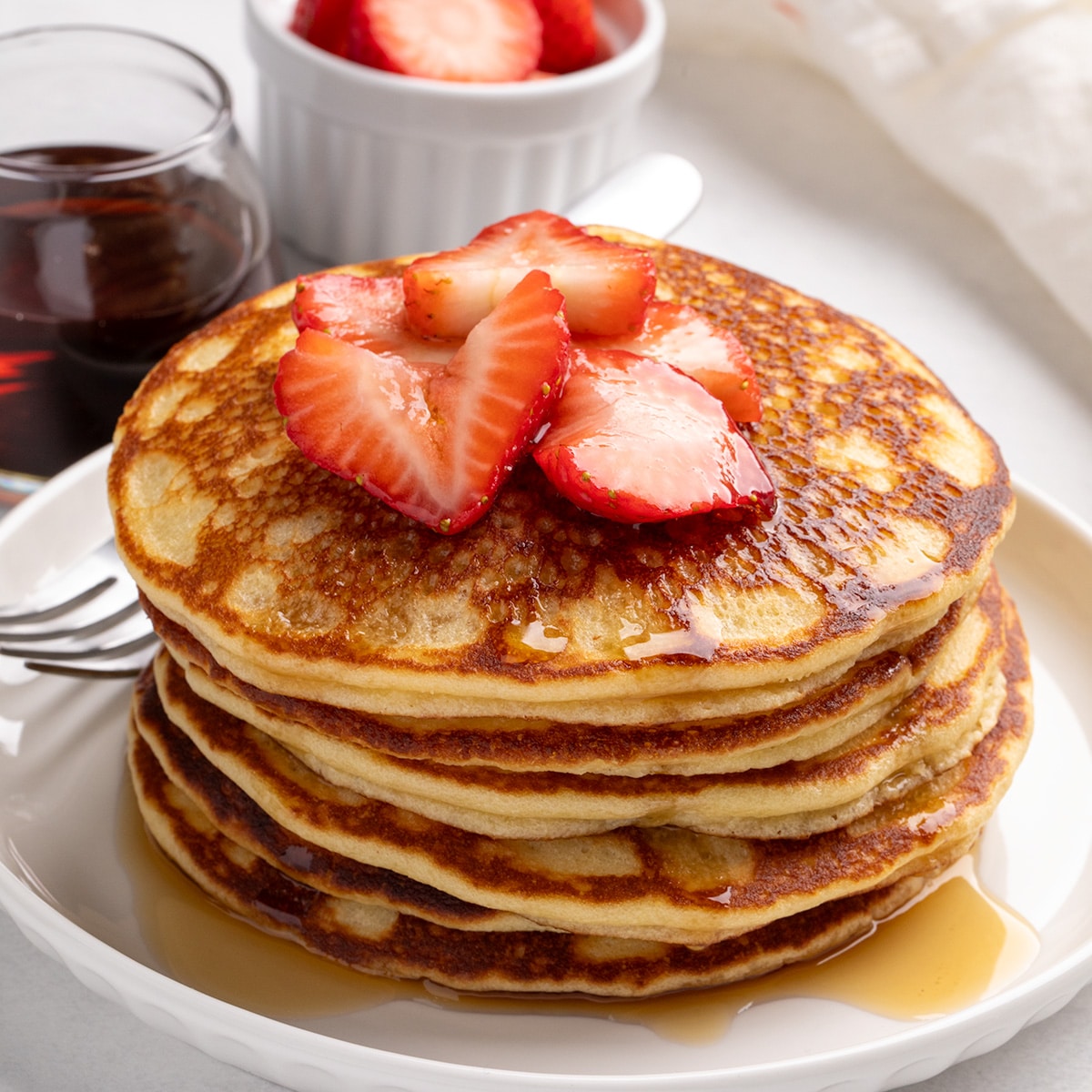
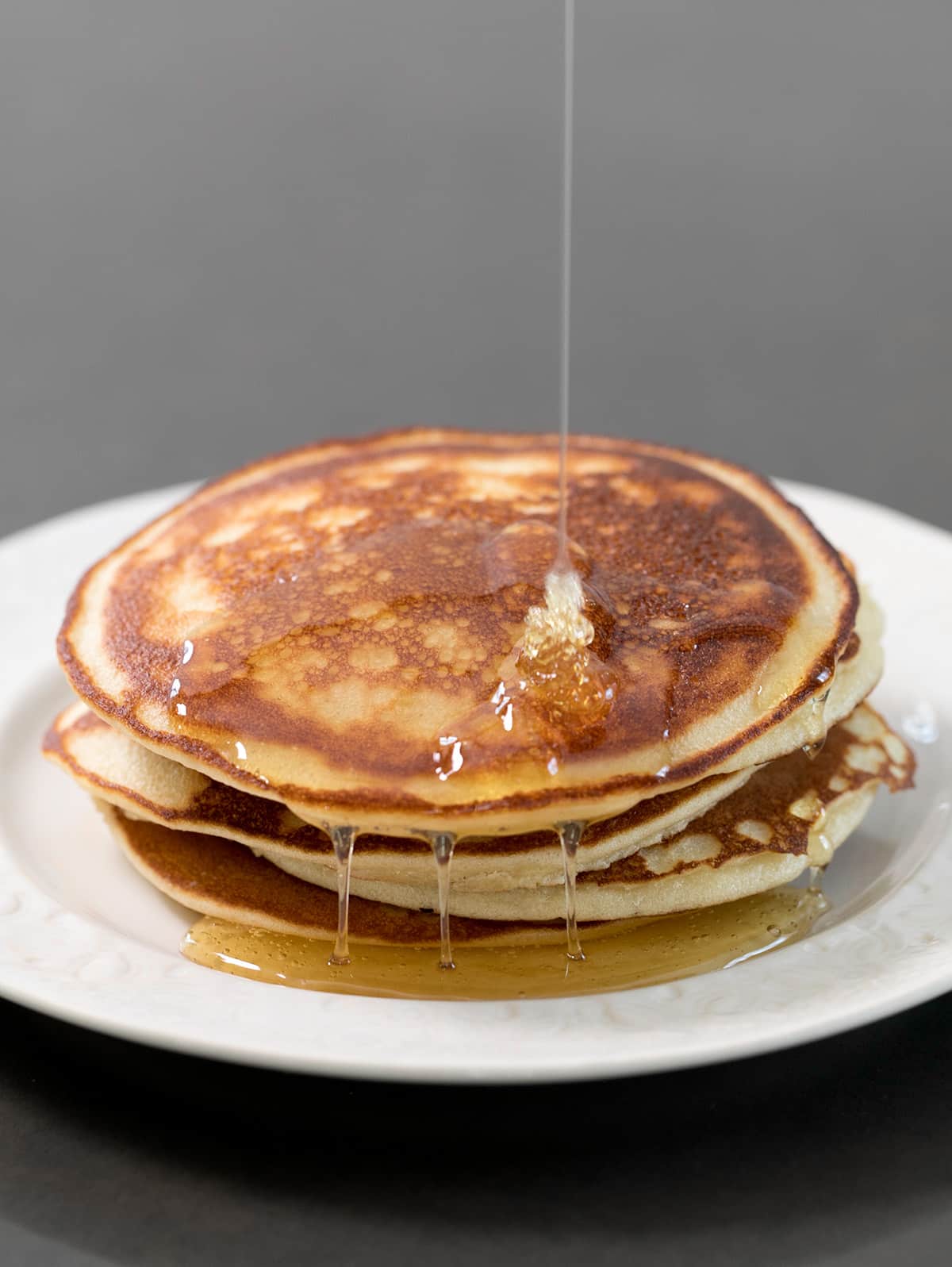
These lightly sweet Paleo pancakes made with almond flour, so they’re naturally high protein. With a bit of tapioca starch for, too, they actually taste like “real” pancakes.
Enjoy them with maple syrup, or plain. And make your own Paleo baking powder easily for fluffy pancakes!

Why this recipe works
These pancakes freeze really well, are high protein, and are so filling they keep you going all morning long.
With a combination of almond flour and tapioca starch, they have structure, the batter is easily pourable, and the pancakes are super moist and tender.
Many recipes made with almond flour tend to taste like almonds, if even just faintly, but this recipe just tastes just like “regular” pancakes!

Recipe ingredients
Here’s what you need to make these pancakes, plus some information on the role of each ingredient:
- Almond flour: Finely ground and sifted blanched almond flour provides much of the structure here. I recommend Wellbee’s brand from Amazon, Blue Diamond from the grocery store, or the superfine variety from nuts dot com. “Blanched” almonds are just almonds that have had their dark brown skins removed; the fine grind of the flour allows all the ingredients to fully combine without any grittiness. Avoid almond meal, which is coarsely ground almonds with their skins still on.
- Tapioca starch/flour: This Paleo-friendly starch helps bind the pancakes together and adds flexibility and lightness, and to absorb some of the excess fat in almond flour. It has no equal, but if you must replace it, try arrowroot. Tapioca starch and tapioca flour are the same thing.
- Paleo baking powder: “Regular” baking powder contains cornstarch, which is not Paleo compliant. If that’s okay with you, just use your regular baking powder (check the label to be sure it’s GF). Otherwise, to make your own Paleo baking powder, combine 1/2 teaspoon baking soda, 1 teaspoon cream of tartar & 1/4 teaspoon arrowroot or tapioca starch.
- Milk: Adds creamy texture from some fat and moisture to bring the batter together. I unsweetened coconut or almond milk in the carton since it’s similar in thickness to cow’s milk and has a neutral flavor (canned coconut milk is way too thick).
- Virgin coconut oil: The type that is solid at cool room temperature, it adds fat for richness, to keep the pancakes soft and cakey, and to help them brown. To avoid all coconut flavor, use triple-filtered coconut oil.
- Eggs: Provide rise for fluffiness, and help bind the pancake batter together for a smooth texture and a rise that holds as they cool.
- Honey: Honey adds sweetness without adding refined sugar and locks in moisture for a tender crumb.
How to make Paleo pancakes (step by step photos)
Combine dry ingredients
In a large mixing bowl, combine the almond flour, tapioca starch, baking powder and salt. Whisk very well for even distribution of ingredients, and to avoid bitter pockets of leavening. The fat in almond flour in particular tends to cause clumps, so be sure to break them up.
Add wet ingredients
Add milk, melted coconut oil, eggs and honey to the bowl of dry ingredients and whisk into a smooth batter.
Let batter rest briefly
The pancake batter will be about as thick as heavy cream. Let the batter sit for about 10 minutes while you heat the griddle or pan so the flours absorb some of the moisture and the batter thickens a bit. If you use the batter right away to make pancakes, they’ll be thinner than we’d like.
Preheat the griddle or skillet
Bring an electric griddle to somewhere between 325°F and 350°F or heat a nonstick or seasoned cast iron skillet over medium heat. Be sure not to make the surface too hot, since almond flour burns easily because of its high fat content. Even if the surface is reliably nonstick, grease the surface to help browning, especially around the edges.
Pour the batter
Use a ladle or measuring cup to pour pools of batter about 1/4-cup each onto the prepared surface. Let them cook until large bubbles form on top and they’re set all around the edges, about 1.5 minutes. They’ll look flat, not shiny, when set).
Flip and finish cooking
Use a wide nonstick spatula to flip the pancakes over. Let them cook for about another 30 seconds to one minute or until set and browned on both sides.
Grease again and repeat with the rest of the batter. You can keep the pancakes warm on a covered plate or on a baking sheet in a 200°F oven.
Expert tips
Make the dry mix ahead
To get a head start on making Paleo pancakes, try mixing the dry ingredients ahead of time and storing the mixture until needed. Since almond flour has so much fat, it can go rancid much more quickly than an all purpose gluten free flour blend. Just should store the mix in the freezer or refrigerator. Just allow it to come to room temperature before completing the recipe as cold almond flour forms clumps.
Measure dry ingredients by weight
Like all baking, pancakes require precision in measurement. And like all flour, almond flour and tapioca starch are easy to measure incorrectly unless you weigh your ingredients on a simple digital kitchen scale.
Use finely ground almond flour
Finely ground almond flour combines effectively with the other ingredients called for, and disappears into the batter rather than adding an unwelcome texture to your cooked pancakes. Not all almond flour is finely ground and sifted, though. If you’re not sure yours is, try sifting it once or twice to remove larger granules before weighing out the amount needed for the recipe.

Ingredient substitutions
Nut free
Paleo baking recipes so often rely on almond flour, and if you can’t have nuts that can be a big hurdle. Instead, try my coconut flour pancakes, which are naturally nut-free.
You can try using finely sifted and blanched hazelnut or sunflower seed flour. If you choose sunflower seed flour, there may be a chemical reaction with the baking soda in baking powder that causes your pancakes to have a light green color, but they’re still safe to eat.
Egg free
Try replacing each egg with one “chia egg” each, or, for both eggs, make a mixture of 2 tablespoons tapioca starch (15 grams total), 1/2 teaspoon additional baking powder, and 2 tablespoons of milk.
Coconut oil
You can use shortening in place of coconut oil. If you’re okay with dairy, try using butter.
Tapioca starch
A unique starch that adds flexibility and is still Paleo-legal, tapioca starch is hard to replace. You can try arrowroot, or superfine sweet white rice flour (also called glutinous rice flour) if the recipe doesn’t have to be strictly Paleo.
Storage instructions
If you have leftover pancakes, or you would just like to make them ahead of time, you can! Just allow them to cool completely before wrapping them tightly in small, single-portion stacks in freezer-safe wrap and placing them in the freezer.
When you are ready to serve pancakes that have been made and frozen in advance, unwrap the stacks, separate the pancakes from each other and place them, still frozen, in a toaster oven. Cook at about 300°F until warm, 1 to 2 minutes.
Make the batter
-
In a large bowl, place the almond flour, tapioca starch, baking powder and salt, and whisk to combine.
-
Create a well in the center of the dry ingredients and add the milk, oil, eggs and honey, and whisk to combine well. The mixture should be smooth and about the thickness of heavy cream.
-
Set the batter aside to sit briefly. It will thicken a bit.
Cook the pancakes
-
Heat a griddle or cast iron skillet (or any other nonstick surface on which you like to make pancakes) over medium heat (on an electric griddle, keep the temperature no higher than 350°F). Lightly grease your griddle surface with additional coconut oil.
-
Pour the pancake batter about 1/4 cup at a time into rounds about 4-inches in diameter. They’ll continue to spread a bit at first, so don’t crowd them.
-
Allow the pancakes to cook until at least a 1-inch border around the perimeter of the pancakes appears set (when they’re set, they’ll lose their shine), about 1 minute 30 seconds.
-
With a wide, thin spatula, turn each pancake over and allow to finish cooking on the other side (about another 30 seconds).
-
Remove the pancakes from the griddle, and repeat with the remaining batter.
-
Serve the pancakes warm with maple syrup or more honey.
Make ahead suggestions
-
You can allow the pancakes to cool completely before wrapping them tightly in freezer-safe wrap and freezing.
-
When you are ready to serve the pancakes, unwrap the stacks, separate the pancakes from each other and place them, frozen, in a toaster oven. Cook at about 300°F until warm, 1 to 2 minutes.
Conventional baking powder is not Paleo compliant only because it usually contains cornstarch (which is almost always still gluten free, but check labels). If that isn’t a problem, just use that.
If you’d like to be sure you’re using 1 3/4 teaspoons Paleo baking powder, make your own by combining 1/2 teaspoon baking soda, 1 teaspoon cream of tartar & 1/4 teaspoon arrowroot or tapioca starch.
Serving: 1pancake | Calories: 215kcal | Carbohydrates: 16g | Protein: 7g | Fat: 15g | Saturated Fat: 4g | Polyunsaturated Fat: 1g | Monounsaturated Fat: 1g | Trans Fat: 0.004g | Cholesterol: 41mg | Sodium: 192mg | Potassium: 51mg | Fiber: 2g | Sugar: 6g | Vitamin A: 146IU | Vitamin C: 2mg | Calcium: 133mg | Iron: 1mg
Nutrition information is automatically calculated, so should only be used as an approximation.
FAQs
Yes! Maple syrup is legal on a Paleo diet. Just like honey is, as both are unrefined, naturally occurring sugars.
No, this recipe cannot be made with almond meal, which is made of coarsely ground almonds that still have their dark brown skins intact. Similar to a gritty rice flour, almond meal won’t combine fully enough with the other ingredients, and will add unpleasant texture to these pancakes.
I find it easier to make these pancakes on an electric griddle, since I can quickly and easily pour more pancakes at a time and still have plenty of room to flip them without disturbing the batter. Since almond flour burns easily, it helps to be able to control the temperature, too.
If you’re using an electric griddle to cook your pancakes, keep the temperature relatively low, at no more than 350°F. You want the pancakes to brown properly, but almond flour has so much fat that it tends to blacken if cooked at too high a temperature. The batter is also relatively thin, so it’s best to let the pancakes set quite a bit before flipping them to cook on the other side.
Did you measure your flours by weight, and did you use finely ground almond flour? If you use almond meal, the batter won’t be cohesive and can be lumpy and runny, which leads to uneven, unfluffy pancakes.
Source link