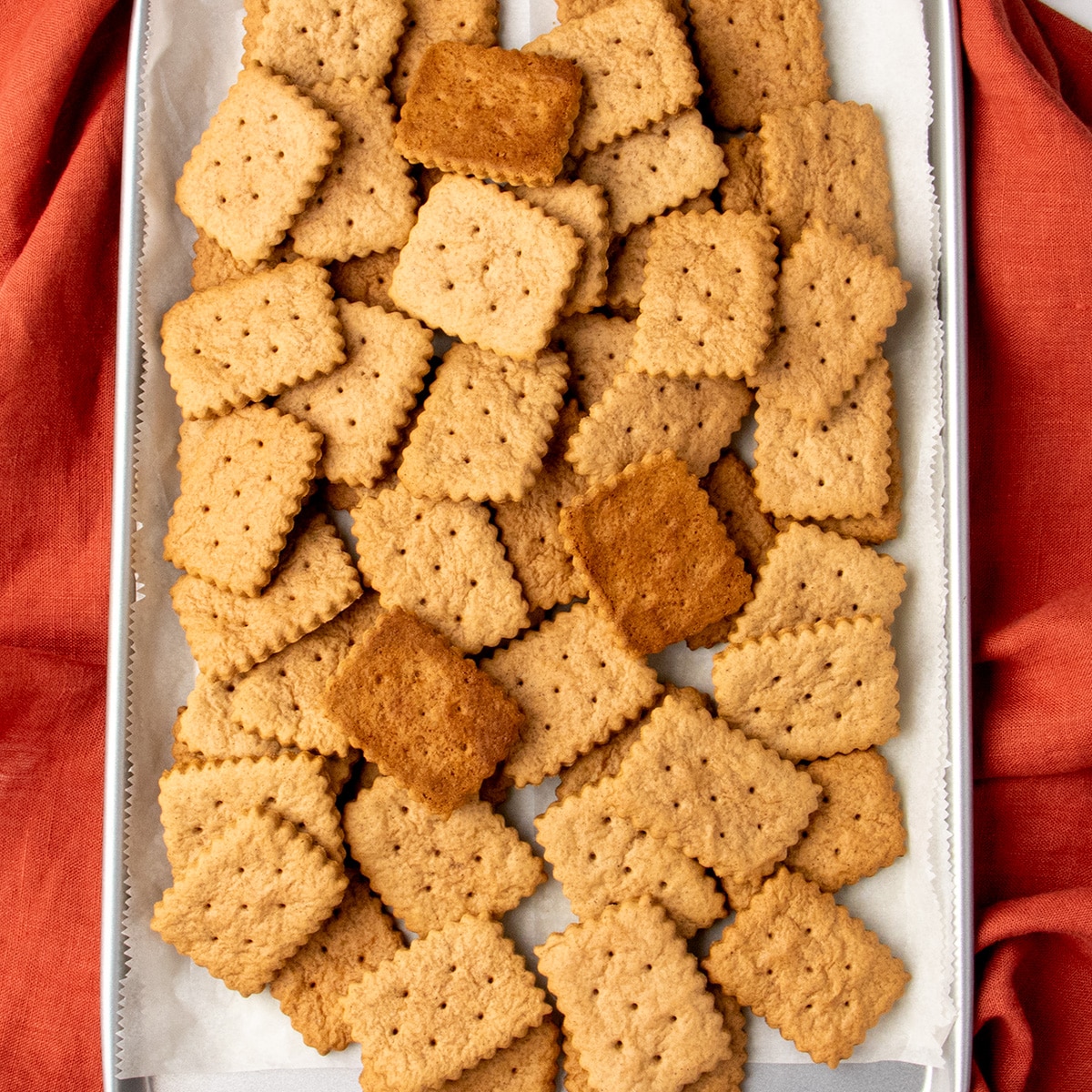
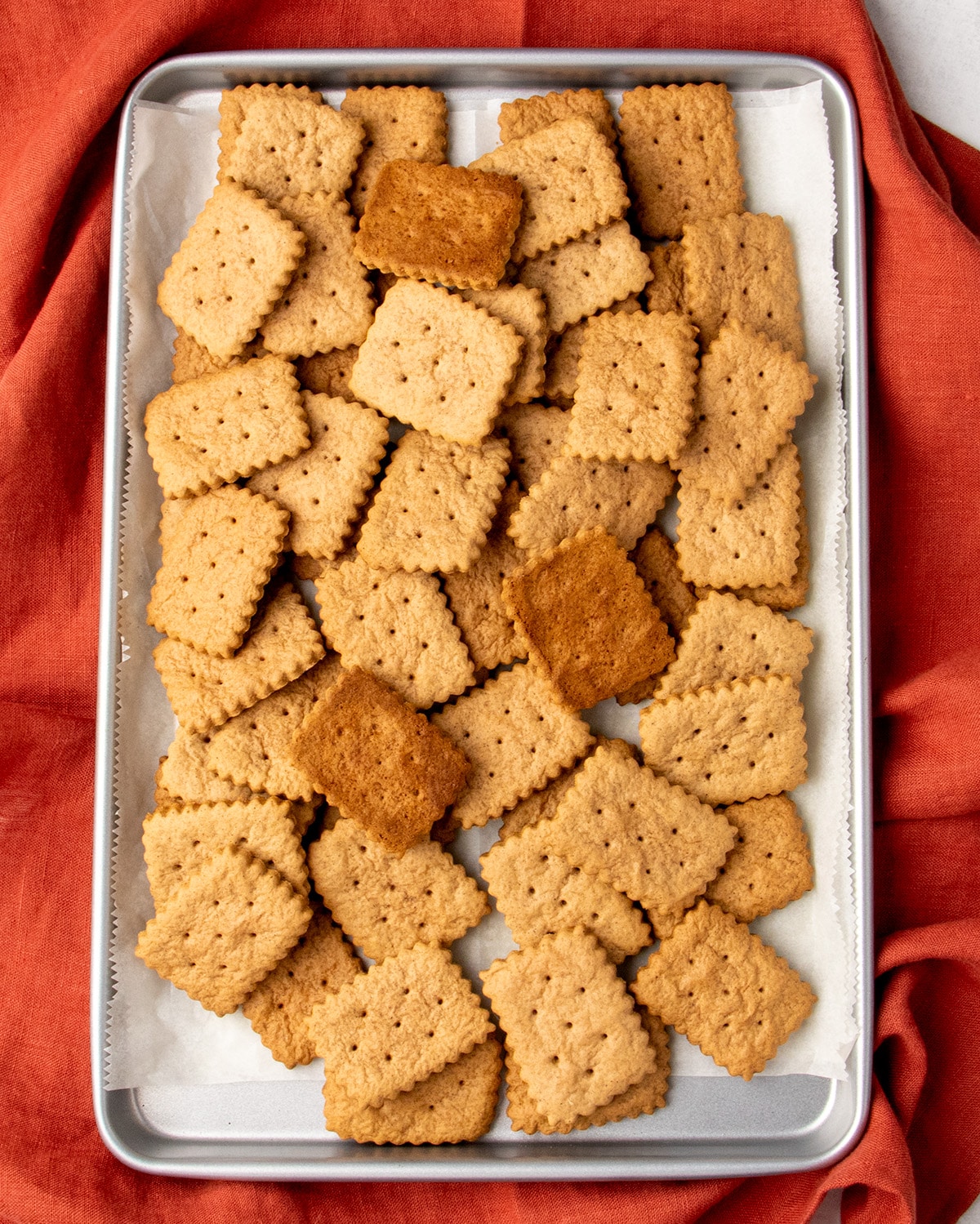
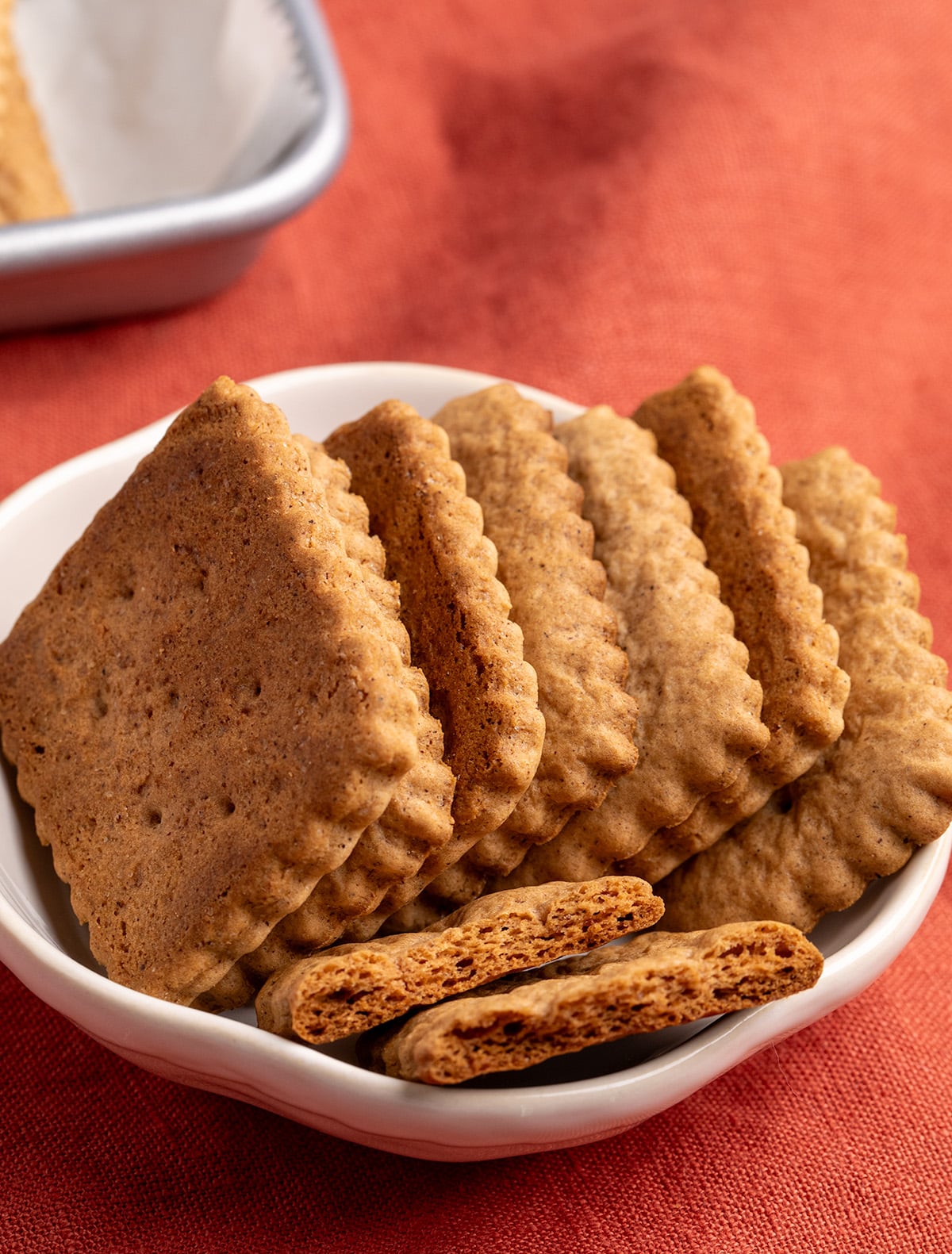
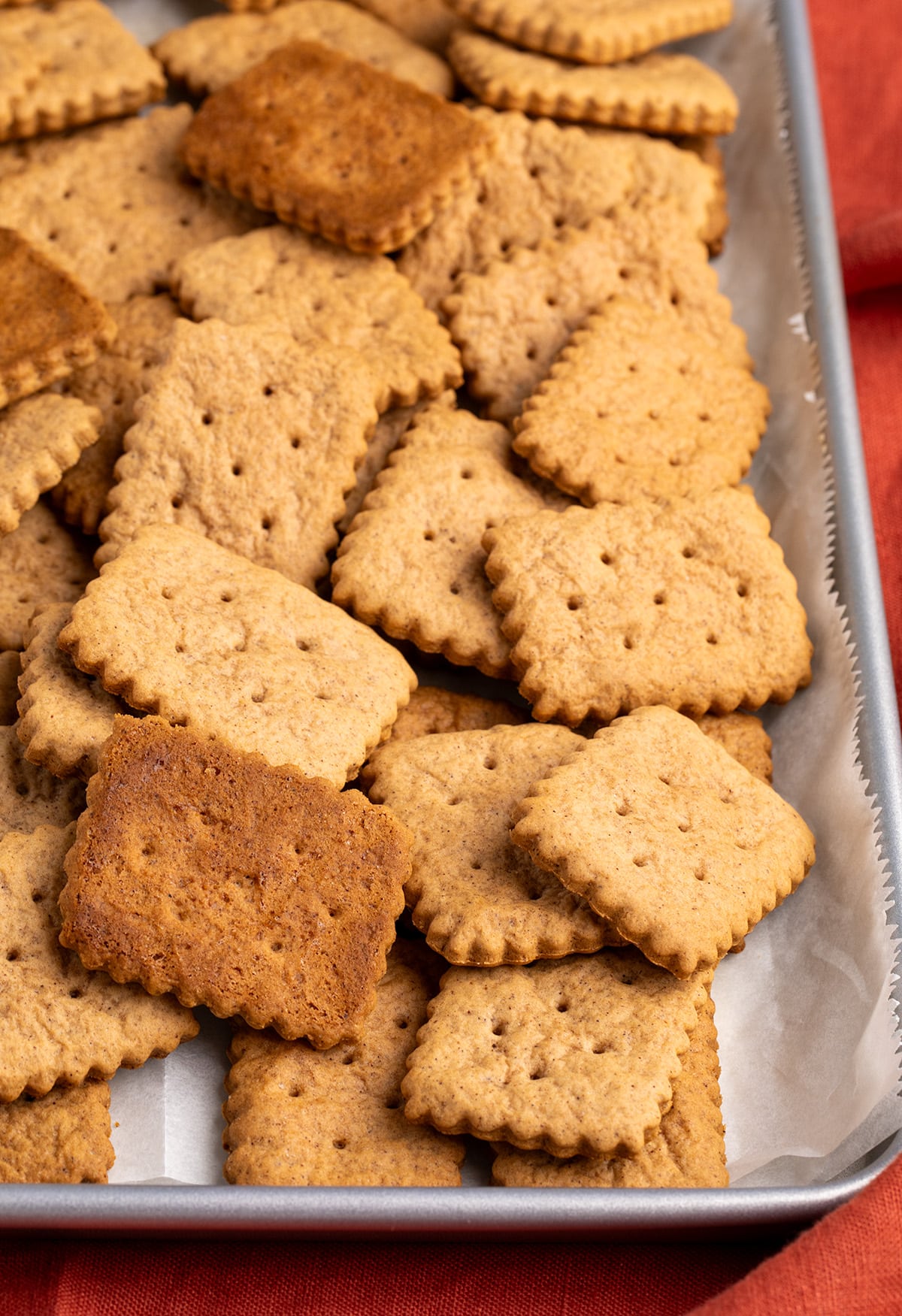
These gluten free biscoff cookies are thin, crisp, and deeply spiced, with the caramelized brown sugar flavor of the classic cookies. The one-bowl dough is easy to make and handle, so it’s easier to get that familiar taste and texture than you think.
Lots of classic brands now make gluten free snacks inspired by their most popular treats, but until Lotus Bakeries adds Biscoff to that list, we’ll have to make our own!
Why this recipe works
Brown and white sugars, honey, and warm spices build the deep caramelized flavor that makes Biscoff cookies so distinctive, without making them overly sweet.
The dough comes together by hand with no eggs, mixer, food processor, or chilling. It stays smooth and workable, so you can roll it thin and cut clean rectangles without having to chill it first.
Thin dough plus a few holes in the tops helps the cookies bake evenly, so they come out golden and firm. And then crisp up completely as they cool.
Recipe ingredients
Here’s what you’ll need to make these cookies at home, plus some information on the role of each element in the cookie recipe. For full ingredient amounts, scroll down to the recipe card below:
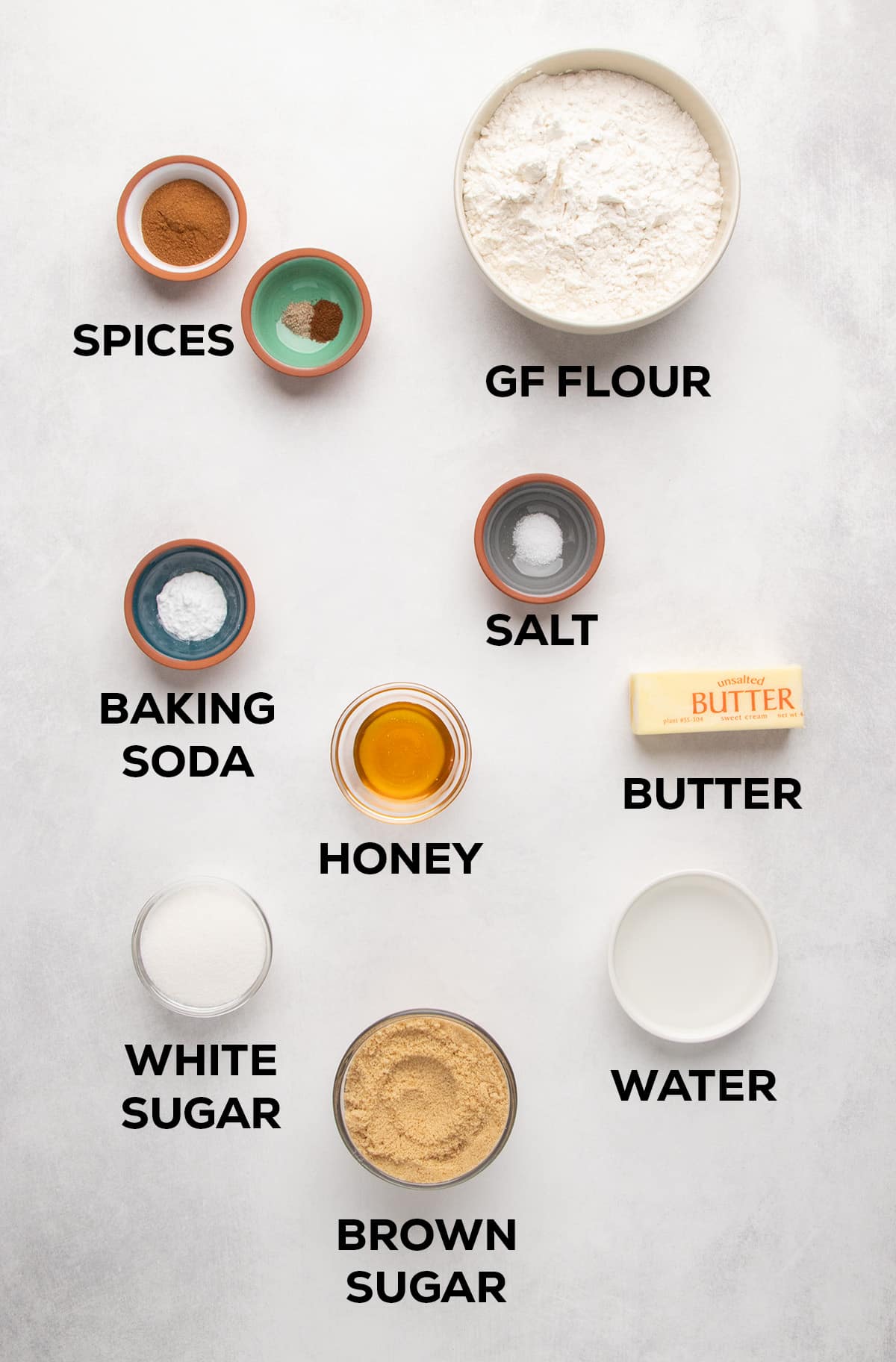
- Gluten free flour: With xanthan gum or a substitute for xanthan gum, it provides the structure and most of the texture for these cookies. Be sure to use something that has finely ground and sifted rice flour in a well-balanced blend for structure, taste and performance. I recommend Better Batter’s original all purpose blend (which already contains enough xanthan gum), Nicole’s Best Multipurpose gluten free flour (plus 1 teaspoon xanthan gum), or Bob’s Red Mill 1-to-1 gluten free baking flour with an additional 1/4 teaspoon xanthan gum (the blend contains some, but not enough to prevent crumbling cookies).
- Cinnamon: The dominant spice flavor, it adds subtle sweetness and warmth.
- Nutmeg: Adds a sharp, slightly bitter and peppery warmth that complements cinnamon.
- Allspice: Similar in flavor to both cinnamon and nutmeg, it acts to balance the other two spices.
- Cardamom: Adds a bright, almost minty flavor to contrast the warmth of the other spices.
- Cloves: Contributes a sharp flavor that adds depth to the balance of spicy flavors.
- Salt: Adds brightness and balances the sweetness of the sugars.
- Baking soda: Adds rise when it reacts with the acid in the brown sugar and honey, and helps the cookies brown in the oven.
- Granulated sugar: Adds sweetness, crispness, and locks in moisture so the cookies don’t dry out.
- Light brown sugar: Adds sweetness and depth of flavor from the molasses, and keeps the cookies from becoming too hard in the oven.
- Butter: Adds buttery flavor, moisture, and fat to help the cookies brown in the oven. Keeping it solid at cool room temperature helps keep the cookies from spreading too much during baking.
- Honey: Helps bind the cookies together with its stickiness, plus adds flavor and moisture.
How to make gluten free Biscoff cookies (step by step photos)
Mix the dry ingredients
Whisk together the flour blend including xanthan gum, all the spices (cinnamon, nutmeg, allspice, cardamom and cloves), salt, baking soda, granulated sugar and brown sugar. This ensures that the base of the recipe is uniform and there are no bitter pockets of leavener.
Add the butter
Chop the butter into cubes to scatter it evenly over the dry ingredients and toss to coat the butter in flour. This will prevent the butter from sticking to itself. Press the tines of a fork or the back of a mixing spoon into the butter pieces to work them into the dry mixture until the mixture resembles brown coarse sand.
Mix in liquids
Mix in 1/4 cup of water and just 1 tablespoon of honey to the dry mixture to form a cohesive light brown cookie dough. If there are any very dry spots in the mixture, add more water by the drop just to those dry spots, like we do with our gluten free pie crust. The dough should be thick and soft, but firm enough that it doesn’t escape between your fingers when you squeeze it.
Roll out the dough
Divide the dough in half, and work with one half at a time so it’s easier to roll it evenly. Sprinkling lightly with more flour on a surface and on top of the dough as necessary to prevent the dough from sticking and tearing, use a rolling pin to roll out the dough into a rectangle about 1/8-inch thick.
Test the dough texture
If the dough feels too fragile to lift up even the edges, it may be too wet. That will lead to a too-soft dough that doesn’t hold its shape and tends to rise less evenly. To fix it, sprinkle the dough with about 1 tablespoon more flour, fold it over on itself to work in the extra flour, and roll it out again.
Cut out shapes
If you have a cookie cutter that’s about 2 1/2 inches x 1 1/2 inches, use it to cut out rectangles in the dough. If not, use a pastry cutter (one that creates a scalloped edge looks pretty) or pizza wheel to cut out as many rectangles about that size as you can. Peel away the dough around the cutouts if you’ve used a cutter, and gather it to reroll.
Place on the baking sheets
Place the cuts about 1/2-inch apart on the prepared baking sheets, since they won’t spread much during baking. If you’re think the cutouts might stretch when you lift them, use an offset spatula to lift them to the prepared baking sheets.
Pierce the tops
Use a toothpick to poke 5 or 6 small holes in each rectangle to help the cookies rise more evenly. My cookie cutter happens to create these holes on its own, but a toothpick works great.
Bake the cookies
Bake the cookies, one baking sheet at a time, at 350°F for about 15 minutes, or until mostly firm to the touch and golden brown. Their color will actually lighten a bit during baking, but they shouldn’t burn on the bottoms at all. The more evenly rolled out the cookies are, the less likely they are to burn on the bottom in spots.
Ingredient substitutions
These cookies are already gluten free and egg free. Here’s how to avoid other potential allergens.
Dairy free
In place of butter, try block style vegan butter like Miyoko’s or Melt brand. They may not become as crispy, though. You can also try virgin coconut oil (the kind that’s solid at cool room temperature) or Spectrum brand vegetable shortening, but you’ll probably need more water since they’re missing the water that’s in butter.
Honey
In place of honey, you can try using maple syrup, but you’ll probably need less water.
Spices
The spices in these cookies really set them apart from our gluten free graham crackers, but you can still make some changes if necessary. In place of the cinnamon, nutmeg an allspice, you can use 2 teaspoons of apple pie spice. The other spices add a lot of flavor that really makes these cookies taste like the original, but you can also leave out the cardamom and cloves or add another 1/4 teaspoon apple pie spice in their place.
Storage instructions
These cookies will keep stored in a sealed glass container at room temperature for about 2 weeks. Be sure to store them in glass, since plastic is porous and the cookies will absorb moisture from the room and lose their crisp texture.
For longer storage, freeze for up to 3 months. They may lose some crispness in the freezer, but it helps if you can freeze them in tempered glass. Just make sure there’s enough headspace for the cookies to expand a bit during freezing.
Can I make these into gluten free Biscoff spread?
Yes! In a blender or food processor, grind about 5 ounces of these gluten free Biscoff cookies (about 18 cookies of this size, or 1/4 of the recipe) into crumbs. Then add 2 tablespoons packed light brown sugar, a pinch of baking soda, a pinch of salt, 1 tablespoon of tapioca starch, and 6 tablespoons of melted Spectrum nonhydrogenated vegetable shortening and blend for about 3 minutes or until smooth. Transfer the spread to a container, and allow it to sit uncovered at room temperature until no longer warm (about 30 minutes). Cover and store at room temperature until firm (about 2 hours). It will harden if stored in the refrigerator, but will soften again when it returns to room temperature.
-
Preheat your oven to 350°F. Line rimmed baking sheets with unbleached parchment paper and set aside.
-
In a large mixing bowl, whisk the flour blend, xanthan gum, cinnamon, nutmeg, allspice, cardamom, cloves, salt, baking soda, granulated sugar, and light brown sugar to combine well. We’ll work out any lumps in the brown sugar in the next step.
-
Chop the butter into tablespoon sized cubes and add it to the mixing bowl. Work the butter into the dry ingredients with the tines of a fork or the back of a spoon until the mixture resembles coarse sand. You’ll naturally break up any lumps in the brown sugar along the way.
-
Add the honey and 1/4 cup water, and mix to combine. Add more water by the drop to any especially dry spots and mix to combine. The cookie dough will come together and should be thick but not stiff.
-
Divide the cookie dough roughly in half and press each half into a round of dough. Work with one half at a time (draping the other half with plastic or a tea towel so it doesn’t dry out).
-
Place the first half of cookie dough on a lightly floured surface, press it into a rough rectangle, and sprinkle the top very lightly with more flour.
-
Use a rolling pin to roll the dough into a rectangle a bit more than 1/8 inch thick. If the dough feels too fragile to lift up even the edges, you may have added too much water, so work in about 1 tablespoon more flour and roll the dough out again.
-
Cut out rectangles about 2 1/2 inches x 1 1/2, and place about 1/2-inch apart on the prepared baking sheets. If you don’t have a cookie cutter that’s about the right size, use a pastry wheel or pizza cutter to cut out rectangles.
-
Peel away the rest of the dough around the cutouts, then place the cutouts about 1/2-inch apart from one another.
-
Use a toothpick to poke 5 or 6 small holes in each rectangle while it’s on the baking sheet.
-
Place the baking sheets in the center of the preheated oven, one at a time, and bake until golden brown and mostly firm to the touch, about 15 minutes. To get a feel for how quickly they will bake, make your first batch in the oven a small one and adjust the baking time appropriately.
-
Allow the cookies to cool on the baking sheet before transferring to a wire rack to cool completely. They will crisp as they cool.
-
Gather and reroll scraps, and repeat with the remaining cookie dough.
This recipe works best with Better Batter’s original all purpose blend or Nicole’s Best multipurpose with 1 teaspoon xanthan gum. It should also work with Bob’s Red Mill 1-to-1 gluten free baking flour if you add 1/4 teaspoon more xanthan gum, since that blend has some, but not enough, binder.
To make your own high-quality gluten free flour blend, check out my mock all purpose gluten free flour blends.
Spices
In place of the cinnamon, nutmeg and allspice, you can use 2 teaspoons apple pie spice for the same taste.
Serving: 1cookie | Calories: 37kcal | Carbohydrates: 7g | Protein: 0.2g | Fat: 1g | Saturated Fat: 1g | Polyunsaturated Fat: 0.04g | Monounsaturated Fat: 0.2g | Trans Fat: 0.04g | Cholesterol: 3mg | Sodium: 24mg | Potassium: 4mg | Fiber: 0.2g | Sugar: 3g | Vitamin A: 29IU | Vitamin C: 0.01mg | Calcium: 3mg | Iron: 0.02mg
Nutrition information is automatically calculated, so should only be used as an approximation.
Source link