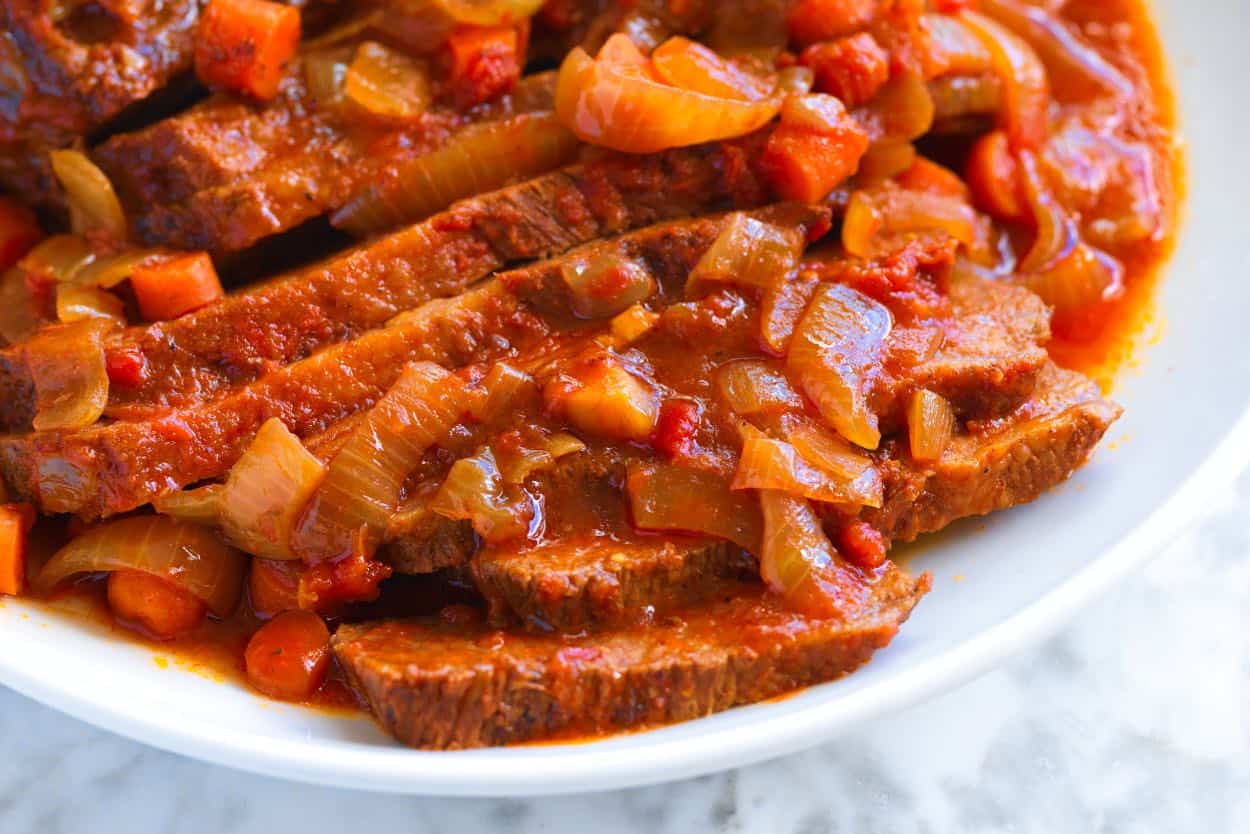
Thanks to slowly braising in the oven, this classic tomato and onion brisket recipe turns out incredibly moist, saucy, and tender.

I’ve been so into this recipe that I haven’t stopped thinking about it since we finally photographed it a few weeks ago. It’s been in the works for a while, and we are so happy to finally share it with you! Brisket is a pretty tough cut of beef. But with this recipe, it slowly braises in our sweet-and-sour sauce made with jammy onions, tomatoes, red wine, and thyme. The beef turns out unbelievably flavorful, and you are left with a rich gravy you’ll want to spoon over just about everything.
Brisket might just be the ultimate comfort food. And the way it makes your kitchen smell is downright intoxicating. This one is perfect for the holidays, a family dinner, or as a genius make-ahead meal, since it actually gets better as it sits in the fridge. Expect a bit of hands-on time in the beginning, but once you’ve browned the beef and cooked the onions, it is completely hands-off. The oven does all the work. (Just like it does when we make braised short ribs, beef stew, and our rosemary crusted ribeye roast.)
Key Ingredients
- Brisket: For this recipe, look for a brisket flat or first cut. Brisket is made up of two different cuts (the flat and the point). The flat (or first cut) is leaner and rectangular, making it perfect for this recipe. We recommend leaving a thin fat cap on top to keep the meat moist and tender during the long braise.
- Onions, Garlic, and Carrots: These are the base of our braising liquid. Cook the onions and garlic slowly until golden, sweet, and almost caramelized. Then, we add carrots for color and sweetness.
- Tomatoes: Both tomato paste and canned crushed tomatoes add richness to our braising liquid. We love the double-concentrated tomato paste sold in tubes. (If you don’t have crushed tomatoes, just pulse canned whole tomatoes in a blender until broken down.)
- Wine and Stock: Use a dry red wine you’d happily drink (you will have some leftover). Lighter-oaked reds like Merlot, Pinot Noir, or Côtes du Rhône are good options. Beef stock or broth makes up the rest of the braising liquid. Homemade beef stock is fabulous, but store-bought is fine.
- Sugar, Paprika, and Herbs: Use brown sugar (light brown is better, but dark works), plus sweet paprika, bay leaves, and fresh thyme.
- Cider Vinegar: We love raw apple cider vinegar with the “mother” (like Bragg). It adds a sweet-sour flavor that cuts through the rich beef.
Find the full recipe with measurements below.

How to Make Brisket in the Oven
First, brown the beef on all sides. We do this for almost all of our slow-cooked and braised beef recipes, including our shredded beef tacos, beef birria, and beef stew. A golden-brown crust adds flavor, helps build the braising liquid, and adds nice texture to the beef. To do it, pat your beef dry, season generously with salt and pepper, then cook in olive oil until well browned on all sides. We’ve done this in a wide skillet (cutting our brisket in half first so it fits), but if you have a stove-top safe roasting pan, you can use it for this step instead.

Remove the browned beef, and cook the onions. Next, you’ll transfer the beef to a plate, lower the heat a bit, then slowly cook lots of sliced onions and garlic until soft, sweet, and browned. You aren’t caramelizing them as you would for French onion soup, but you do want good color and sweetness.
Now, make the braising liquid. To the sweet, browned onions, add the carrots, tomato paste, paprika, and bay leaves, and cook for about 2 minutes (just to darken the tomato paste).

Then, pour in red wine and reduce it by half. This is a great time to scrape anything that’s stuck to the bottom and sides of the pan, adding even more flavor to your braising liquid. Finally, stir in the beef stock, canned crushed tomatoes, brown sugar, vinegar, and fresh thyme.


Braise the beef with the sauce until tender. Transfer the beef and sauce to a roasting pan, and spoon some sauce over the top. Cover tightly with foil, then bake for 3 to 4 hours. We check around 3 hours to see how it is progressing and to make sure the braising liquid is still saucy. If it looks dry, we add a splash more stock, then continue baking until tender. In our oven, the brisket you see in our photos took just a few minutes over 4 hours.

Let the brisket rest and cool for at least 30 minutes (preferably longer). If you slice the beef right as it comes out of the oven, the meat will shred, and you won’t get those pretty, distinct slices. Wait a bit, though, and it will slice easily. We recommend resting for at least 30 minutes, or longer if you have the time. The best option is to let the brisket cool completely, then cover and refrigerate overnight. The next day, lift the beef from the chilled sauce (saving the sauce for reheating), then slice. Once reheated, the beef turns out even more flavorful and tender than if you served it on day one.
What to Serve With Braised Brisket
Our recipe below serves 8 to 10 people, so when we were testing this one, we had plenty of leftovers. That meant we could enjoy it with a variety of sides. Our favorite was potatoes. Adam loves our potatoes au gratin or scalloped potatoes, but a simple mashed potato or even roasted potatoes for scooping up that braising liquid are perfect.
While not entirely traditional, polenta would be excellent, as would buttered noodles. Any of your favorite roasted veggies would fit here, too. Think roasted carrots, roasted cabbage (my favorite), or even a medley of roasted vegetables. Finally, since this is a rich, hearty dish, a lighter fresh salad with a zippy vinaigrette would be welcome. I particularly love our balsamic dressing or lemon vinaigrette.

Brisket
-
PREP
-
COOK
-
TOTAL
This classic sweet and savory braised brisket calls on lots of golden, almost caramelized onions, garlic, and a simple sauce of red wine, crushed tomatoes, cider vinegar, and brown sugar to yield incredibly moist, saucy, tender meat.
While you can slice and serve after 30 minutes of rest time, this method for cooking brisket is famous for being made ahead. In fact, both the flavor and texture get better with a night in the fridge. Once out of the oven, let the brisket cool to room temperature in its pan, then cover and refrigerate overnight. The next day, lift the cold beef out of the sauce (scraping any excess back into the pan) and slice it against the grain. Return the slices to the sauce and reheat gently in a skillet or a 325°F oven until warmed through.
8 to 10 Servings
You Will Need
6 pounds brisket flat, trimmed with a little fat cap left
3 tablespoons extra-virgin olive oil
1 tablespoon fine sea salt
1 teaspoon freshly ground black pepper
4 medium onions, sliced ¼-inch thick
6 garlic cloves, peeled and lightly smashed
4 medium carrots, chopped into ½-inch pieces (2 cups)
3 tablespoons tomato paste
1 cup (240 ml) dry red wine
1 ¾ cups (420 ml) beef stock or broth
1 (28-ounce) can crushed tomatoes
¼ cup (55 g) brown sugar
2 teaspoons sweet paprika
2 ½ tablespoons cider vinegar
2 bay leaves
8 thyme sprigs
Directions
1Heat the oven to 325°F (162°C). Pat the brisket dry and season all over with the salt and pepper.
2Heat the olive oil in a wide skillet or stovetop-safe roasting pan over medium-high heat. Add the brisket and sear until well browned on all sides. (If the brisket is too big to fit your skillet, cut it in half and brown in batches.) Transfer the meat to a plate.
3Reduce the heat to medium-low. Add the onions and garlic to the pan and cook, stirring occasionally, until the onions are golden brown and nearly caramelized, 15 to 20 minutes. Stir in the carrots, tomato paste, paprika, and bay leaves. Cook, stirring often, until the tomato paste darkens slightly, 2 to 3 minutes.
4Pour in the red wine and bring to a simmer, then use a wooden spoon to scrape up any browned bits from the bottom of the pan. Cook until the wine is reduced by about half, then stir in the beef stock, crushed tomatoes, brown sugar, cider vinegar, and thyme. Taste, then season with salt if needed.
5If using a skillet, spread about a third of the sauce across the bottom of a roasting pan. Add the browned brisket (fat cap facing up), then pour the remaining sauce over and around the meat so it is covered, but not completely submerged. (If you seared in a roasting pan, return the meat to the pan and spoon some of the sauce over the top.)
6Cover the pan tightly with foil and cook in the oven until fork-tender and an internal thermometer inserted into the middle reads between 205°F and 210°F, 3 ½ to 4 hours. We recommend checking for doneness at the 3-hour mark to gauge how much longer it needs. If the sauce reduces too much and the pan looks dry, stir in some extra beef stock.
7Once out of the oven, let the brisket rest in the sauce for at least 30 minutes, or longer if possible, before slicing against the grain. (If you slice right away, the beef will shred rather than slice cleanly.) See tips above for resting overnight and reheating the next day.
Adam and Joanne’s Tips
- Storing: Keep brisket and sauce in an airtight container in the fridge for up to 4 days or freeze for up to 2 months. Thaw overnight in the refrigerator. Reheat gently with some of the sauce in a skillet or covered in a 325°F oven until warmed through.
- When slicing, look for the longer lines of muscle fibers running through the meat. You want to slice perpendicular to them (against the grain). We like ¼-inch to ⅜-thick slices.
- The nutrition facts provided are estimates.
Nutrition Per Serving
Serving Size
1 of 10 servings (about 6 ounces beef plus ½ cup sauce)
/
Calories
466
/
Total Fat
18.4g
/
Saturated Fat
5.7g
/
Cholesterol
182.2mg
/
Sodium
1080.4mg
/
Carbohydrate
15.4g
/
Dietary Fiber
2.4g
/
Total Sugars
9.7g
/
Protein
60.4g
Source link